

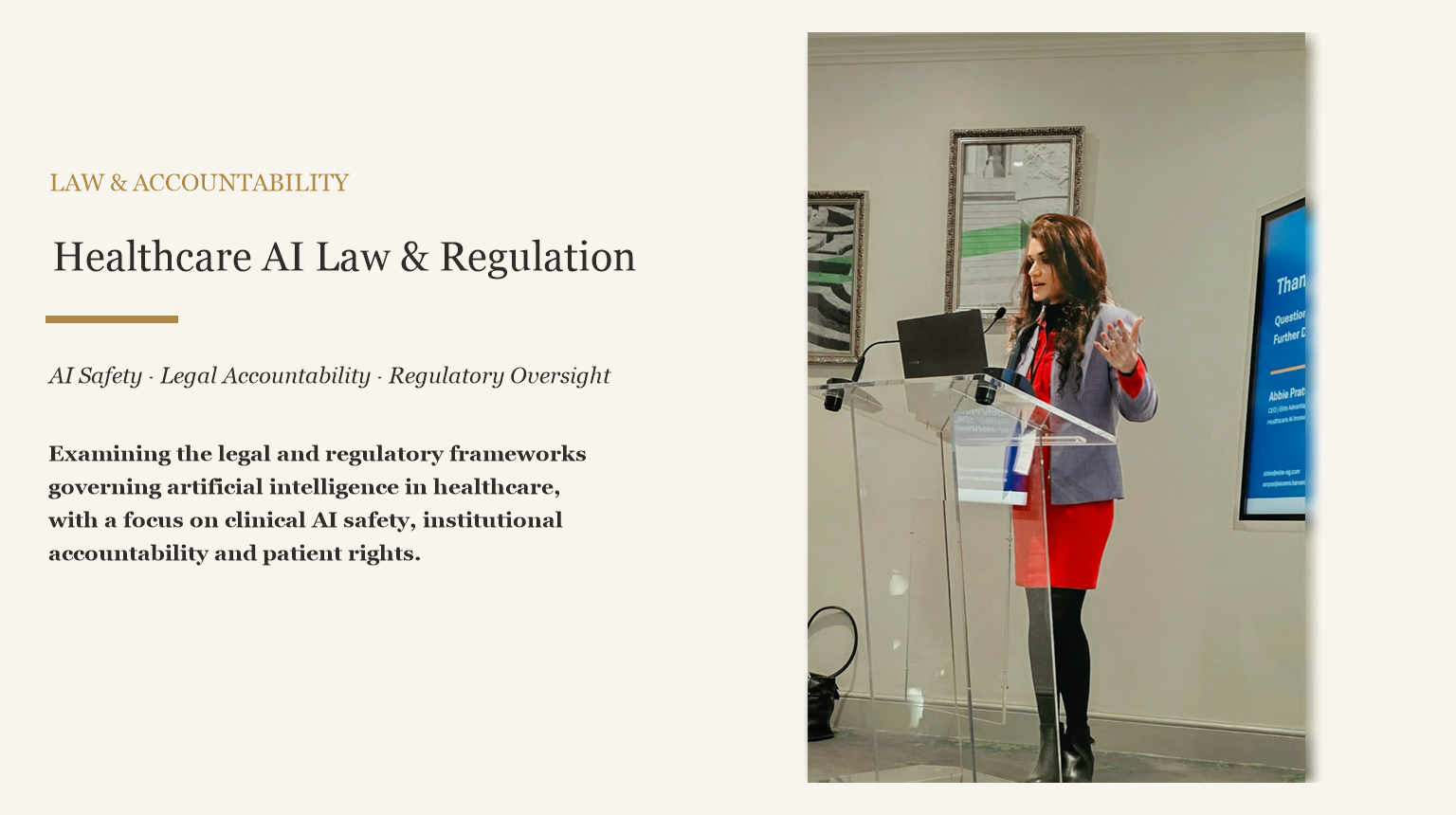
Professional & Research Background
I have spent more than two decades in technology leadership and entrepreneurship, leading large-scale technology and digital transformation initiatives in healthcare and other highly regulated industries. In recent years, my work has increasingly focused on artificial intelligence in healthcare, particularly clinical AI safety, governance and regulation.
My studies in AI in Medicine at Harvard Medical School further informed my understanding of the intersection between technological innovation, clinical decision-making and patient safety, prompting a deeper examination of the legal and regulatory challenges surrounding clinical AI.
The increasing use of artificial intelligence in healthcare raises legal and regulatory questions that extend well beyond technology. Who bears responsibility when a clinical AI system fails? What rights do patients have when medical records are generated or modified by AI? How should existing laws address clinical decisions increasingly influenced by automated systems?
Throughout my career, I have worked extensively with issues involving corporate governance, business law, regulatory compliance and organizational accountability. I also pursued coursework in law during my graduate studies at Harvard University. Both experiences have shaped how I examine legal and regulatory issues in healthcare AI today.
Areas of Research & Interest
My healthcare AI research examines these questions through existing legal statutes, regulatory frameworks, judicial precedents and emerging healthcare practices.
Areas of Research & Interest
Clinical AI safety regulation and post-deployment oversight
Legal responsibility and institutional accountability in AI-enabled healthcare
Patient rights, access to medical records and evidence preservation
Generative AI in clinical documentation and professional liability
Regulatory standards for clinical AI safety, validation and accuracy claims
Legal safeguards for vulnerable and underrepresented patient populations
My research explores where existing legal protections remain adequate, where their application becomes uncertain, and where additional regulatory safeguards may be necessary as artificial intelligence becomes increasingly integrated into healthcare delivery.